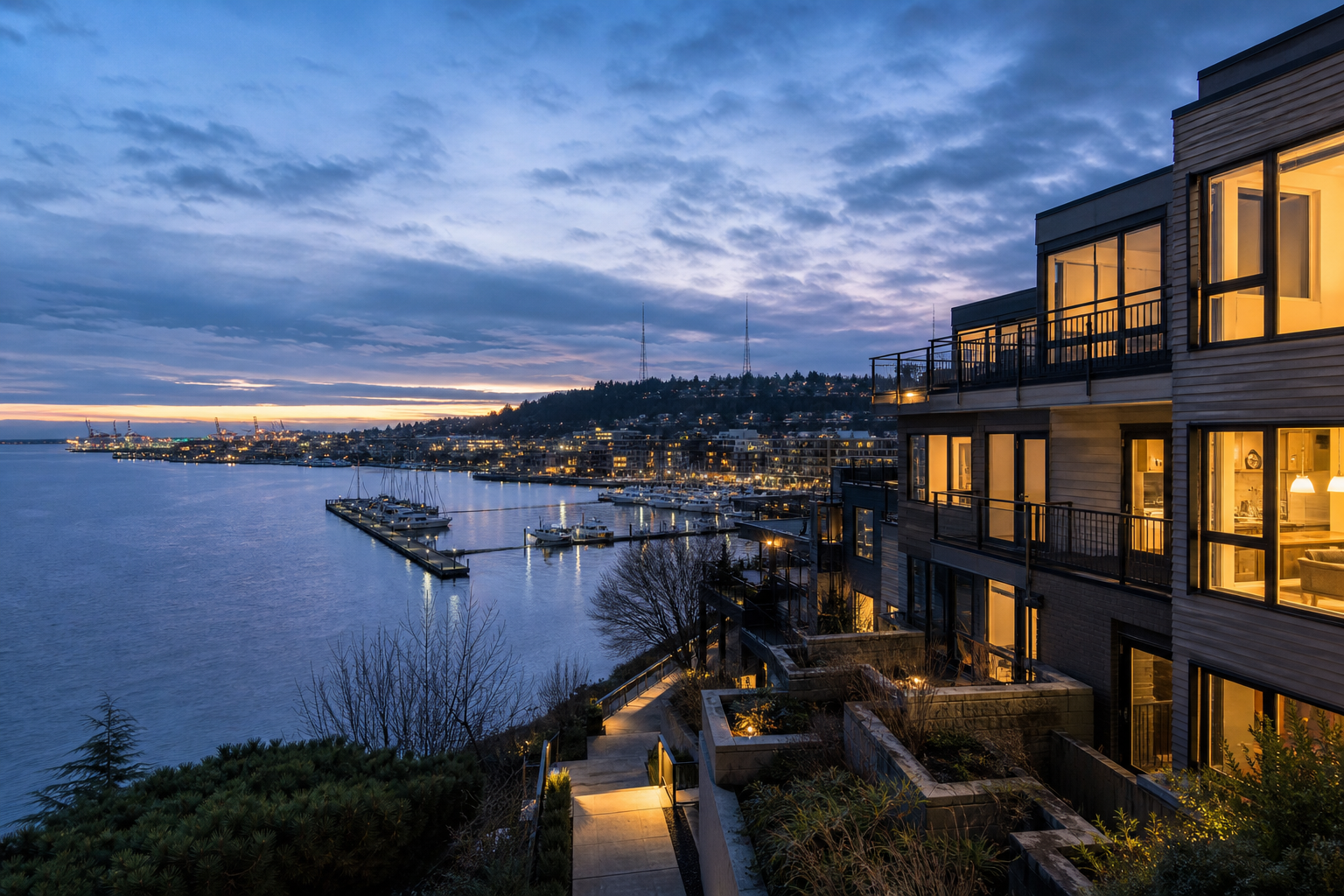
Seattle's Waterfront Is Finished. What Does That Mean If You Live Next to It?
The Central Waterfront project is complete. Pier 58 reopened in July 2025, and the finished Waterfront Park officially opened that September. So the question for anyone buying nearby has changed: it's no longer about what's coming, it's about what the park is actually like now that it's here. The city publishes a scorecard that answers that, and it's more useful than any visitor count.
Key Takeaways
- Overlook Walk opened in October 2024, connecting Pike Place Market to the shoreline over Alaskan Way. Pier 58 reopened July 25, 2025, and the completed Waterfront Park officially opened September 6, 2025.
- Visitation is large and the published figures vary a lot by methodology: 8.356 million visitors in 2025 per the Historic Waterfront Association, and more than 3.2 million visits during the Grand Opening Season per city-reported figures, including 611,000 on Overlook Walk.
- The city's Waterfront Park Performance Standard Review for 2025 found Programming and Activation fully met at 100%, while Maintenance came in at 86% against a 90% standard and Public Safety at 85%, both scored Not Met.
- Park inspections: five of fourteen passed, nine failed. Guest experience surveys came back 90% positive from park visitors.
- Units facing the promenade get the view and the access, and also the ambient noise and weekend crowds. Floor level, orientation, and soundproofing decide whether you live with a view or a soundtrack.
What the renovation actually changed
I've been walking clients through Seattle neighborhoods since 2010, and this is the most significant public-space change I've seen in the city. Removing the Alaskan Way Viaduct and building out Waterfront Park didn't just improve the view. It rewired how people move through downtown.
Overlook Walk is the clearest example. It opened in October 2024 as a pedestrian overpass, park space, and gathering venue connecting Pike Place Market with the waterfront over Alaskan Way. Before it, getting from the Market to the water meant stairs, traffic, and the shadow of the viaduct. Now it's a walk. It closes nightly at 10 p.m., which is worth knowing if your route home would use it.
Pier 58 reopened on July 25, 2025 as one of the last pieces of what The Urbanist described as an "$806 million revamp of the central waterfront." The completed park officially opened that September.
That means the construction-timing question is closed. For the last several years the honest advice to a buyer near the shoreline was to understand what was still being built and when it would open. That advice is now obsolete, and any article still giving it, including earlier versions of this one, is out of date.
How busy is it, really?
Very, and the published numbers disagree enough that you should know which one you're being quoted.
The Waterfront Park Performance Standard Review for 2025 cites the Historic Waterfront Association reporting 8.356 million visitors to the park in 2025. City-reported figures covered in January 2026 put it at more than 3.2 million total visits during the Grand Opening Season, with 611,000 of those on Overlook Walk, 61% of visitors from Washington state, 24% from Seattle itself, and $2.5 million in vendor revenue. The same reporting elsewhere gives 2.4 million visitors between May 1 and September 30, 2025.
Those aren't contradictions so much as different counting methods over different windows, and none of the sources reconciles them. So when someone quotes you a waterfront visitor number, the useful follow-up is what period and whose count.
What all of them agree on is the direction. This is a year-round civic destination with events, public art, and daily foot traffic, not a seasonal tourist corridor. For a buyer, that changes the lifestyle calculus of anything within walking distance of the shoreline, in both directions.
The part nobody reads: how the park is actually performing
The city publishes a scorecard, and it's the most useful document available for anyone considering a home nearby.
The Waterfront Park Performance Standard Review for 2025 scores the park against defined standards. The results are mixed in a way that matters:
- Programming and Activation: 100%, standard met. A full 30 out of 30. The events and activation side is working.
- Maintenance: 86%, standard not met. The standard is 90%.
- Public Safety: 85%, standard not met.
- Park inspections: five of fourteen passed, nine failed.
- Work orders: 393 of 424, or 93%, assigned within 48 hours.
- Guest experience: 90% of park visitors and 92% of program participants responded positively, from 3,364 survey responses, up from 1,281 the year before.
Read those together and you get a picture that no visitor count gives you. The park is extraordinarily popular, people who go enjoy it, the programming is excellent, and the city's own review says maintenance and public safety are falling short of the standards set for them.
That's the honest answer to what it's like to live next to this. Not a reason to avoid the corridor. A reason to go stand on the specific block, at night and on a weekend, before you decide what proximity is worth to you. And a reason to ask what a building's own security and maintenance arrangements look like, because a busy public space next door raises the value of both.
The trade-off buyers need to understand
Higher visitation is a lifestyle asset with a real cost attached, and I'm direct with every client about it.
Units directly facing the promenade get the views and immediate park access. They also get ambient noise, evening event traffic, and weekend footfall. Units a few blocks inland, or a few floors up, often offer quieter living while staying a short walk from the water.
In a high-rise neighborhood the building matters as much as the unit. Floor level, orientation, and the building's soundproofing determine whether you're living with a view or living with a soundtrack. That's not an argument against waterfront proximity, it's an argument for being specific about which building and which floor before you start making offers.
I visit units at different times of day for exactly this reason. Which direction a unit faces is the factor buyers overlook most, and on this corridor it's compounded by what's happening on the street below at 9 p.m. on a Saturday in July.
What about the market?
I'm not going to quote you spring figures in December, and I'd be skeptical of anyone who does.
The downtown condo market has been inventory-heavy and price-soft through 2026, and that's still broadly true. NWMLS reported King County condo inventory at 7.05 months in September, and in October the region-wide condo median was down 13.0% year over year with condo pending sales down 24.2%. Those are current, they're regional and county figures rather than waterfront-specific, and they tell you buyers have real choice and real negotiating room.
What I won't tell you is that a window is closing. Nobody knows that, the data moves monthly, and urgency built on eight-month-old prices is how people end up overpaying for a unit on the wrong floor.
I also won't give you an area median for Downtown or Belltown. In a submarket built almost entirely of mid-rise and high-rise buildings, a handful of closings in one tower moves the whole figure, and the resulting number tells you about that building's unit mix rather than about anything you'd buy. Recent sales inside the specific building, read against that building's financials, is the comparison that means something.
Before you fall for the location
Check how the building finances itself. I review the full package with buyers: the resale certificate, the reserve study, the operating budget, and the last two years of meeting minutes. A pending special assessment can erase whatever you saved on price, and on this corridor there's a particular reason to look hard: envelope and waterproofing exposure on a building facing Elliott Bay is not theoretical.
I also check project financing approval early, since not every Seattle building qualifies for the loan you planned on.
FAQ
Is the waterfront project finished?
Yes. Overlook Walk opened in October 2024, Pier 58 reopened July 25, 2025, and the completed Waterfront Park officially opened September 6, 2025. Advice about timing a purchase around remaining construction is out of date.
How many people actually visit?
A lot, and the published figures depend on who's counting. The Historic Waterfront Association reported 8.356 million visitors in 2025, as cited in the city's Performance Standard Review. City-reported figures put the Grand Opening Season at more than 3.2 million visits, with 611,000 on Overlook Walk. Ask what period and whose methodology when you see a number.
Is the park well maintained?
Partly. The city's 2025 Performance Standard Review scored Programming and Activation at 100% and standard met, while Maintenance came in at 86% against a 90% standard and Public Safety at 85%, both scored Not Met. Nine of fourteen park inspections failed. Guest experience surveys were 90% positive.
Is a promenade-facing unit worth it?
Depends on how you live. You get the view and immediate access, along with noise, evening event traffic, and weekend crowds. A few floors up or a block inland often gets you most of the benefit with much less of the cost. Visit the specific unit at night and on a weekend before deciding.
Should I buy now because prices are soft?
Soft prices and more inventory are real and they give you negotiating room. They are not a reason to rush, and anyone telling you a window is closing is guessing. Decide based on the building, the floor, and whether you want to live there.
Does walkability to the park help resale?
Access to public amenities is consistently among the factors urban buyers cite, so the finished park is a durable asset the corridor didn't have before 2024. Whether it's already priced into a specific unit depends on the building, the floor, and the orientation, which is a block-level question rather than a neighborhood one.
The bottom line
The waterfront is built, it's busy, and the city's own scorecard says the programming is excellent while maintenance and public safety are falling short. All three of those are true at once, and all three matter if you're going to live there.
If you're considering a building near the shoreline, let's go walk it at the hour you'd actually be home.
About Kim Reidy
Kim Reidy is a Senior Broker and Director of Relocation at Pointe3 Real Estate in Seattle who has been helping corporate transferees and individuals find the right neighborhood since 2010. A Certified Negotiation Expert (CNE) and Certified Buyer Agent Expert (CBAE), she's known as Seattle's "neighborhood whisperer."
Pointe3 Real Estate · (206) 237-6391
Equal Housing Opportunity. Kim Reidy is a Broker with Pointe3 Real Estate, licensed in Washington State (DOL license 106408) and regulated by the Washington State Department of Licensing. Visitation figures vary by source and methodology; performance scores are from the City of Seattle's published review for 2025 and are updated periodically. Market figures change monthly. This article is general information only, not legal, tax, or financial advice.