Where Should Microsoft Redmond Employees Live in the Seattle Area?
You have two broad options: live on the Eastside for the shortest path to campus, or live in Seattle and plan the lake crossing. The crossing is the defining constraint of this relocation, and the honest version of the advice starts with your actual commute rather than with a neighborhood list. Rail now makes several Seattle neighborhoods genuinely workable for a Redmond job, which was not true a few years ago.
Key Takeaways
- Redmond Technology Station sits on the Microsoft campus at 156th Avenue NE and NE 40th Street, served by the 2 Line.
- Capitol Hill, the University District, Roosevelt, Northgate, Westlake, and Judkins Park all have one-seat rides to the Eastside, because the 1 and 2 Lines share every station from Northgate through International District/Chinatown.
- Stations south of International District/Chinatown, including Beacon Hill, Mount Baker, and Columbia City, require a transfer. Ballard and West Seattle have no station at all.
- Sound Transit Express Routes 545 and 542 still run to Redmond and survived the 2026 restructure unchanged, and Route 547 is a night bus running every 30 minutes between Marymoor Village and Westlake.
- Microsoft's own Connector shuttle may serve additional neighborhoods. Route coverage is an internal employee benefit that changes, so confirm current stops with Microsoft transportation before it factors into where you buy.
How does the Seattle-to-Redmond commute actually work?
It's the first thing I address with every Microsoft employee I work with, because it shapes every other decision. Seattle is west of Lake Washington, Redmond is east, and that crossing is the constraint everything else bends around.
Rail changed this, and recently
The 2 Line runs Lynnwood to Downtown Redmond, and Redmond Technology Station sits on the campus itself, at 156th Avenue NE and NE 40th Street. The cross-lake segment opened March 28, 2026, which is what made a one-seat Seattle-to-campus ride possible at all.
Because the 1 and 2 Lines share every station from Northgate through International District/Chinatown, the neighborhoods with a one-seat ride are Capitol Hill, the University District, Roosevelt, Northgate, Westlake, and Judkins Park. If you want to live in Seattle and ride a train to your desk, those are your options.
Here's the distinction that catches people. "On light rail" and "one seat to Redmond" are different claims. Stations south of International District/Chinatown, including Beacon Hill, Mount Baker, and Columbia City, are on the 1 Line and require a transfer. Ballard, Wallingford, and West Seattle have no station, and won't for years: West Seattle Link is targeted for 2035 with the Avalon station cut, and Ballard is "as soon as 2042" and conditional on funding.
Express buses, which survived the restructure
Route 545 connects downtown Seattle with downtown Redmond, and Route 542 connects Redmond with the University District. Both came through the 2026 ST Express restructure unchanged.
Their frequencies are worth knowing before you plan around them. The 545 runs roughly every 10 minutes at weekday peak, 15 midday, 30 at night, and 30 to 60 on weekends. The 542 is sparser: about 20 at peak, 30 midday and nights, 30 to 60 on weekends. Transit writers have also questioned how much time the 545 actually saves against the train on the same trip, so compare the two for your specific origin rather than assuming the express wins.
Late nights
Route 547 runs every 30 minutes as a night bus between Marymoor Village and Westlake, roughly midnight to 4:30 a.m. Monday through Saturday, stopping at Downtown Redmond, Redmond Technology, Bellevue Transit Center, South Bellevue, Mercer Island, and International District/Chinatown. If you work late or attend evening events, that stop list should shape your address search, because the 2 Line runs roughly 4:30 a.m. to 12:30 a.m. on weekdays and Saturdays and starts an hour later on Sundays.
Driving, and the Connector
If you drive, you're on SR-520 or I-90 depending on where you start, and SR-520 is tolled with travel times that vary a lot by hour.
Microsoft also operates the Connector, a private commuter shuttle network, which has historically served Seattle neighborhoods where public transit to Redmond is indirect. I'd treat Connector coverage as something you confirm rather than something you plan around. Routes and stops are an internal employee benefit, they've changed over the years, and hybrid work reshaped a lot of employer shuttle programs after 2020. Ask Microsoft transportation for the current route list once you have an offer, and if the Connector is going to be the reason a particular neighborhood works for you, get that in writing before you buy rather than after.
That's not skepticism about the program. It's that a shuttle route is a benefit decision someone else makes, and a mortgage is a decision you can't unwind.
Seattle neighborhoods worth looking at
If you want the train
Capitol Hill is the strongest all-around option. Its station is on the shared alignment, so you get more frequent trains and a one-seat ride to campus. It's also among the pricier parts of the city, and homes there have generally taken longer to sell, which means more time to vet a building.
The University District and Roosevelt give you direct rail plus a dense Metro network, and the U District is a major bus destination in its own right, which gets you places the train doesn't. That rail-plus-bus combination is what actually makes a neighborhood work without a car, and it's rarer than a station alone.
Northgate rounds out the north-end rail options, with Pinehurst added September 30, 2026.
If the neighborhood matters more than the commute
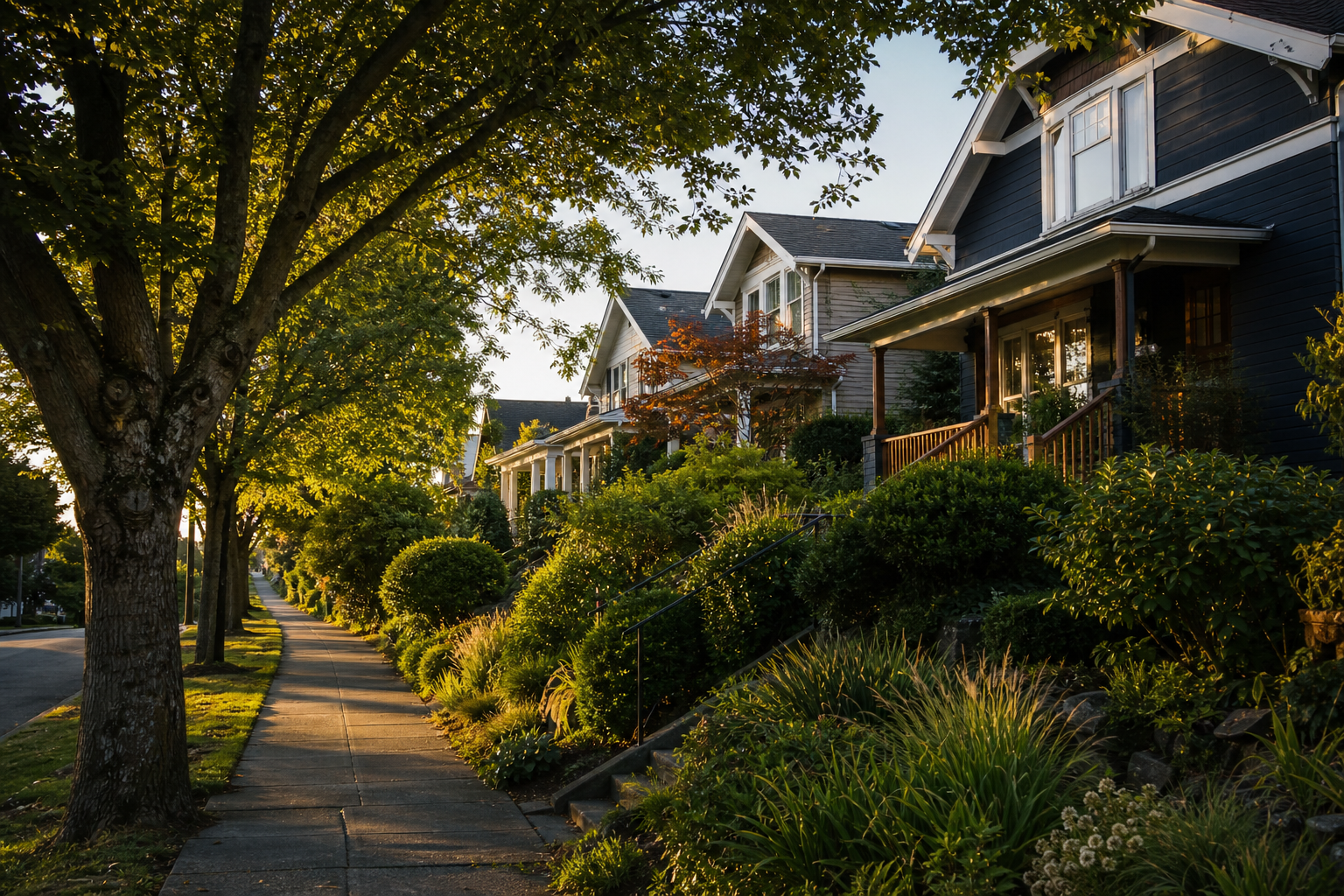
Ballard is a historically maritime district that's become one of the city's densest, most walkable neighborhoods: breweries, restaurants, a weekend farmers market, and a mix of craftsman houses and mid-rise condos. Wallingford sits north of Lake Union with a quieter, more residential feel, craftsman bungalows, a compact commercial strip on 45th, and Green Lake nearby. West Seattle is a peninsula with a genuinely separate identity: the Junction has its own commercial core and Alki provides waterfront.
All three are legitimate places to live and none has rail. The commute from any of them is a bus, a car, or a Connector route you've confirmed. West Seattle is the most complex, because you're crossing the West Seattle Bridge before you ever reach SR-520.
I'd rather tell you plainly that Ballard may not suit a daily Redmond commute than sell you on it and let you discover that in February. If you're in the office two days a week, that calculation is entirely different from five.
What about prices?
I'm not publishing neighborhood medians here, and the reason is that they'd mislead you more than help. An area median blends houses, townhomes, and condos, so a figure for Ballard tells you about the mix of what sold rather than about anything you'd buy, and the same number swings substantially from quarter to quarter on sales mix alone.
When you have a shortlist, I pull comparable sales for those specific properties in your housing form and price band. That's a different and much more useful number.
Should you buy on the Eastside, in Seattle, or rent first?
The Eastside case
Living closer to campus means a shorter, simpler commute, and Redmond has four 2 Line stations of its own: Overlake Village, Redmond Technology, Marymoor Village, and Downtown Redmond. Bellevue's downtown core and Kirkland's waterfront offer real urban amenities with a different character from Seattle's.
For employees with families, or anyone who simply wants the shortest path between home and desk, the Eastside case is straightforward.
One caution: "living in Redmond" tells you very little by itself. Those four stations serve different parts of the city, and a Redmond address away from them can need a local bus, a bike, or a car to reach campus, which is a connection a well-placed Seattle address doesn't have.
The Seattle case
If the urban texture of Seattle is part of why you took the offer, the Eastside can feel like a trade you didn't want to make. That's a legitimate reason to choose a longer commute, as long as you've ridden it.
Renting first is usually the right call
If you're arriving without firsthand knowledge of the region, rent for six to twelve months before buying. You'll learn which corridor fits your schedule, which neighborhoods match your actual life, and whether you want the city or the Eastside before committing six figures to the answer.
I handle that side too, through Seattle Rental Group with an agent tour team, so I can set you up in either city while you figure it out. I bring this up because it's usually the right advice and because most agents won't give it, since a lease pays a fraction of a sale.
It's especially sensible here. Choosing between two cities on opposite sides of a lake, based on a commute you've never done, in weather you haven't lived through, is a lot to get right on the first try. And if your in-office expectation changes after you arrive, which it often does, a lease means that costs you a conversation instead of a transaction.
FAQ
Can I live in Seattle and work at Microsoft Redmond?
Yes. Capitol Hill, the University District, Roosevelt, Northgate, Westlake, and Judkins Park all have one-seat rides on the 2 Line to Redmond Technology Station, which sits on the campus. Routes 545 and 542 also connect downtown and the U District to Redmond.
Which Seattle neighborhoods do not work well for this commute?
Anywhere requiring a transfer or a bus to start. Stations south of International District/Chinatown need a transfer to reach the Eastside, and Ballard, Wallingford, and West Seattle have no station at all, with rail targeted for 2035 in West Seattle and no sooner than 2042 in Ballard.
Does Microsoft still run the Connector, and where does it stop?
Microsoft operates the Connector shuttle network, but routes and stops are an internal employee benefit that changes over time. Confirm current coverage with Microsoft transportation once you have an offer, and don't let an unconfirmed route determine where you buy.
Is the Eastside or Seattle better?
It depends on what you're optimizing for and, increasingly, on how many days you're in the office. The Eastside gives you the shortest commute. Seattle gives you urban density and street life with more commute planning. Neither is objectively right.
Should I rent first?
If you're arriving without regional knowledge, yes. It lets you test a commute and a neighborhood before buying, and the cost of being wrong about a neighborhood is far lower on a lease than on a purchase.
How late does transit run?
The 2 Line runs roughly 4:30 a.m. to 12:30 a.m. weekdays and Saturdays, and roughly 5:30 a.m. to midnight Sundays and holidays. After that, Route 547 runs every 30 minutes overnight between Marymoor Village and Westlake Monday through Saturday. Confirm current schedules with Sound Transit.
Ready to map it out?
Tell me which building you report to and how many days a week you're expected in, and I'll map specific addresses against your real commute before you tour anything. That one answer narrows the city faster than any price filter.
About Kim Reidy
Kim Reidy is a Senior Broker and Director of Relocation at Pointe3 Real Estate in Seattle who has been helping corporate transferees and individuals find the right neighborhood since 2010. A Certified Negotiation Expert (CNE) and Certified Buyer Agent Expert (CBAE), she's known as Seattle's "neighborhood whisperer."
Pointe3 Real Estate · (206) 237-6391
Equal Housing Opportunity. Kim Reidy and Pointe3 Real Estate are not affiliated with or endorsed by any employer named here. Transit routes, schedules, and employer shuttle programs change; verify current service with Sound Transit, King County Metro, or your employer. This article is general information only, not legal, tax, or financial advice.