How the South Lake Union Tech Corridor Affects Seattle Real Estate
The South Lake Union corridor concentrates jobs, rental supply, and condo demand into one dense high-rise neighborhood. Amazon still anchors it, and the more accurate picture in 2026 is not a neighborhood gaining new employers so much as one recirculating space that large tenants have given up. For a buyer or renter, that makes the specific building, floor, and orientation matter more than any headline about headcount, including your own employer's.
Key Takeaways
- Amazon was reported in September 2026 to be letting its roughly 81,000-square-foot lease at 428 Westlake Avenue North lapse. Per King County records the lease runs through 2027 with two five-year renewal options, so Amazon has the right to stay and is reportedly declining it. Amazon has not confirmed the move.
- That follows a pattern rather than standing alone: Amazon left 180,000 square feet at 2201 Westlake in 2020 and gave up roughly three-quarters of the 539,000-square-foot West8 tower in 2023.
- The new tenants are largely backfilling vacated space. General Motors and Databricks are taking space in West8, which is in Denny Triangle at 2001 8th Avenue and is the tower Amazon left. Apple is expanding in South Lake Union into space Meta gave up. Anthropic is also expanding in the neighborhood.
- Docusign and Perkins Coie were reported downsizing over the same stretch, so the leasing activity is not all in one direction.
- South Lake Union is mostly mid-rise and high-rise housing, so HOA financials, project financing approval, and which way a unit faces will outweigh anything the corridor does to a neighborhood average.
What affects your outcome most inside the corridor?
The building you buy or rent in, not the corridor. South Lake Union is a neighborhood of apartments and condominiums with very few detached houses. You're shopping buildings, not yards, and in a high-rise district two units a block apart can behave like different markets.
Amazon's headquarters is the reason most people know the neighborhood. Worth knowing that not every Amazon job sits here: the company has also expanded in Bellevue since 2017. I'd never price a condo on the assumption that a particular employer's jobs stay in a particular neighborhood, and that caution applies to your own job too.
Why the building matters more than the neighborhood
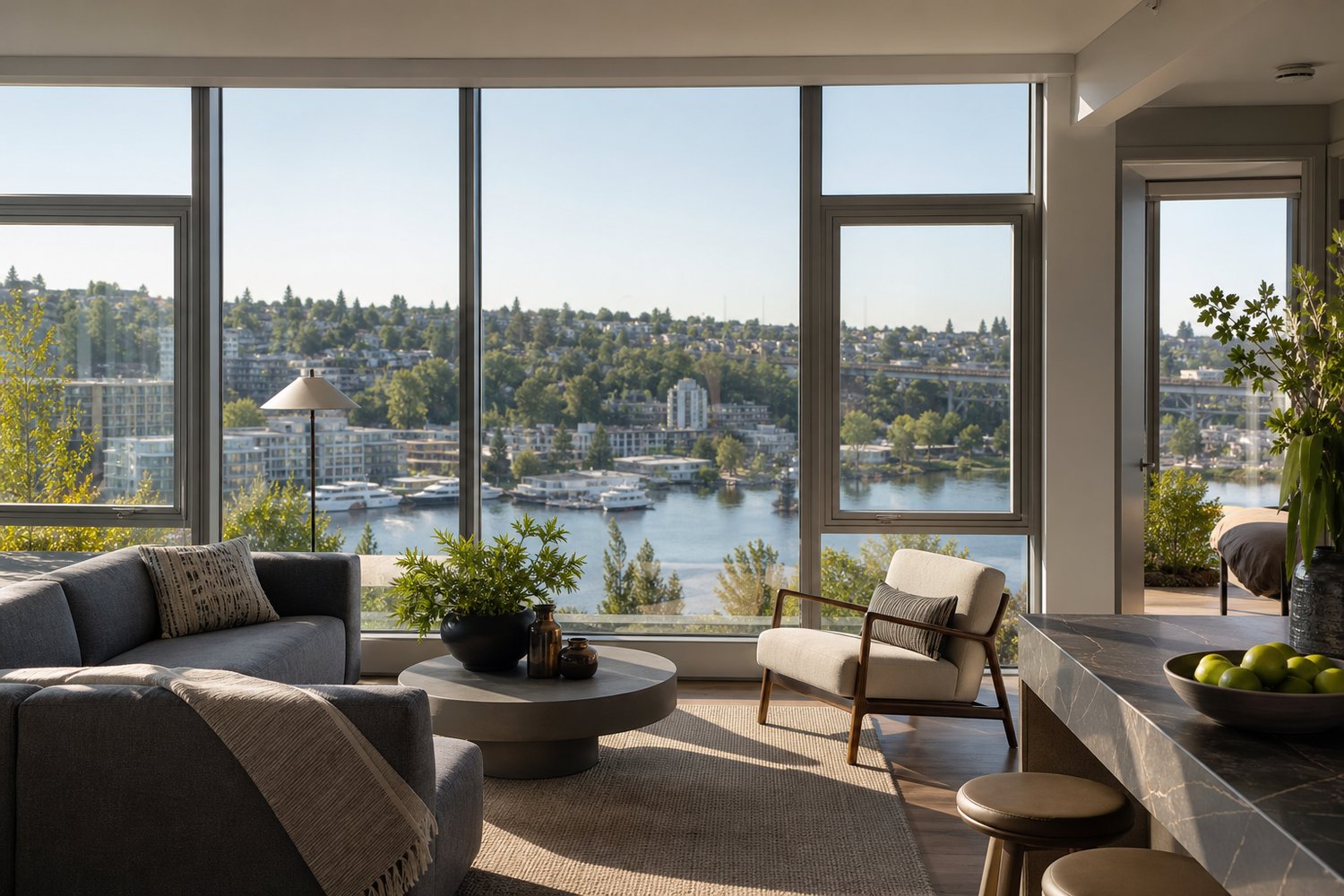
Views, noise, floor level, and the health of the HOA make or break a decision here, and none of them appears in a neighborhood median.
When I work with a condo buyer in this part of the city, I go through the full HOA package before we go under contract: the resale certificate, the reserve study, the operating budget, and the last two years of meeting minutes. A pending special assessment can erase whatever you saved on purchase price. I also check FHA and conventional project approval status early, because your lender underwrites the building as well as you, and not every Seattle building qualifies.
Then I visit specific units at different times of day. Which direction a unit faces is the factor buyers overlook most, and a listing photo will never tell you how the afternoon sun or the street noise lands. Because accessible housing is a specialty of mine, I also look at step-free entries, the route from the garage, and elevator reliability when a client needs them.
What about the neighborhood numbers?
I'm not publishing area medians here, and in this neighborhood they'd actively mislead. South Lake Union and the areas beside it are built almost entirely of mid-rise and high-rise buildings, which means a handful of closings in one tower can move a whole area median. A studio-heavy building closing eight units in a quarter pulls the figure down hard, and that movement tells you about that building's unit mix rather than about the market.
What's useful is recent sales inside the specific building you're considering, read against that building's financials. Two units in the same tower can trade far apart on floor, exposure, and what the HOA has or hasn't funded, and that spread is the actual information.
Is Amazon pulling back from South Lake Union?
The reporting describes a continuing reduction in Seattle office space, not a single decision, and not an exit from the city either. Both halves of that matter.
A September 2026 report said Amazon planned not to renew at 428 Westlake Avenue North, approximately 81,000 square feet. King County records show the lease running through 2027 with two five-year renewal options, and Amazon is reportedly letting it lapse rather than exercising them. Amazon did not confirm the move, saying it regularly evaluates its corporate office space.
Set beside the earlier moves, the direction is consistent: 180,000 square feet at 2201 Westlake left in 2020, roughly three-quarters of the 539,000-square-foot West8 tower given up in 2023, and now this. Separately, more than $20 million has been reported spent upgrading Amazon buildings at 550 Terry Avenue North and 551 Boren Avenue North, which the company bought together in 2021. I'd treat the upgrade and purchase figures as reported numbers from a different source than the lease story, and I haven't independently confirmed them.
So the honest summary is that Amazon is both reducing leased space and investing in buildings it owns. Neither fact cancels the other, and neither tells you what a condo three blocks away is worth.
Who else is taking space, and where exactly?
This is where the popular version gets the geography wrong, so it's worth being precise.
General Motors and Databricks are taking space in West8, at 2001 8th Avenue. That building is in Denny Triangle, not South Lake Union, and it's the tower Amazon largely vacated. Apple is expanding in South Lake Union, into space Meta gave up. Anthropic is also expanding in South Lake Union. Over the same period, Docusign and Perkins Coie were reported downsizing.
Read that list carefully and it's a different story from "the neighborhood is diversifying." Most of it is space changing hands rather than new demand arriving. That's genuinely good news for landlords and for the blocks involved, because occupied buildings support the restaurants and services at street level. It's a weaker signal about housing demand than a headline implies.
Here's the honest read for a buyer. More employers can widen who a neighborhood works for over years. It does not tell you what a specific condo on a specific block will sell for this month, and anyone promising that is guessing. What affects your block this season is the supply of comparable units, the building's finances, and your own timeline.
Should you buy or rent near the corridor?
It depends on how long you'll stay and how healthy the building is. I run both versions before a client commits.
When renting makes sense
If you might move within a couple of years, or you're relocating and still learning the city, or your work location isn't settled, renting keeps you flexible while the corridor's employer mix sorts itself out. Given that the office market here is actively recirculating, "my job will be in this neighborhood in three years" is a shakier assumption in 2026 than it was in 2019, and that's an argument for a lease rather than a mortgage.
Read the lease closely, especially the term and the renewal terms. That matters more than the zip code.
When buying makes sense
Buying works best when you've confirmed the building's financials, the project's financing approval, and a unit you'd be happy in regardless of which company is hiring this quarter. Don't let the purchase ride on one employer's headcount, including your own. If your job could move between South Lake Union, Bellevue, or elsewhere, your neighborhood choice should survive that.
That's not a market call. It's just that a condo is a ten-year decision and an office lease is a three-to-eleven-year one, and you don't control either.
FAQ
How has Amazon's South Lake Union campus affected condo prices and rents?
It concentrated demand in a neighborhood that is now mostly mid-rise and high-rise buildings. But condo values and rents move building by building, not neighborhood-wide, and price depends on the building's financials, the floor, the orientation, and timing. I can pull comparable sales for the specific buildings you're considering.
What happens to South Lake Union real estate if Amazon keeps reducing its office footprint?
One lease decision doesn't decide a housing market, and Amazon's reductions have so far been accompanied by other tenants taking space, though often the same space rather than new space. Watch the building you're considering, its HOA health, and comparable inventory rather than a headline.
Which companies besides Amazon are expanding in the area?
Apple and Anthropic are expanding in South Lake Union, with Apple taking space Meta gave up. General Motors and Databricks are taking space in West8, which is in Denny Triangle rather than South Lake Union, and is the tower Amazon largely vacated. Docusign and Perkins Coie were reported downsizing over the same period.
Is South Lake Union better for renting than buying in 2026?
Neither is better in general. It comes down to your time horizon and the specific building. Renting keeps you flexible, and the office market's current churn is a reasonable argument for flexibility. Buying makes sense when the HOA financials are sound, the building qualifies for your loan type, and you plan to stay.
Where to go from here
The corridor shapes the neighborhood. The building, the unit, and your timeline shape your outcome. If you're weighing a purchase or a move near the corridor, I'll review the HOA financials, check financing approval, and visit units with you at different times of day.
One disclosure, since this post names companies I have a relationship with as a reader of their news and not otherwise: I use AI tools in my own business, including for research and drafting. It doesn't change the analysis above, but you should know it.
Schedule a consultation and we'll look at the specific buildings.
About Kim Reidy
Kim Reidy is a Senior Broker and Director of Relocation at Pointe3 Real Estate in Seattle who has been helping corporate transferees and individuals find the right neighborhood since 2010. A Certified Negotiation Expert (CNE) and Certified Buyer Agent Expert (CBAE), she's known as Seattle's "neighborhood whisperer."
Pointe3 Real Estate · (206) 237-6391
Equal Housing Opportunity. Kim Reidy is a Broker with Pointe3 Real Estate, licensed in Washington State (DOL license 106408) and regulated by the Washington State Department of Licensing. Kim Reidy and Pointe3 Real Estate are not affiliated with or endorsed by any company named here. Lease and office market details are as reported at the time of writing and were