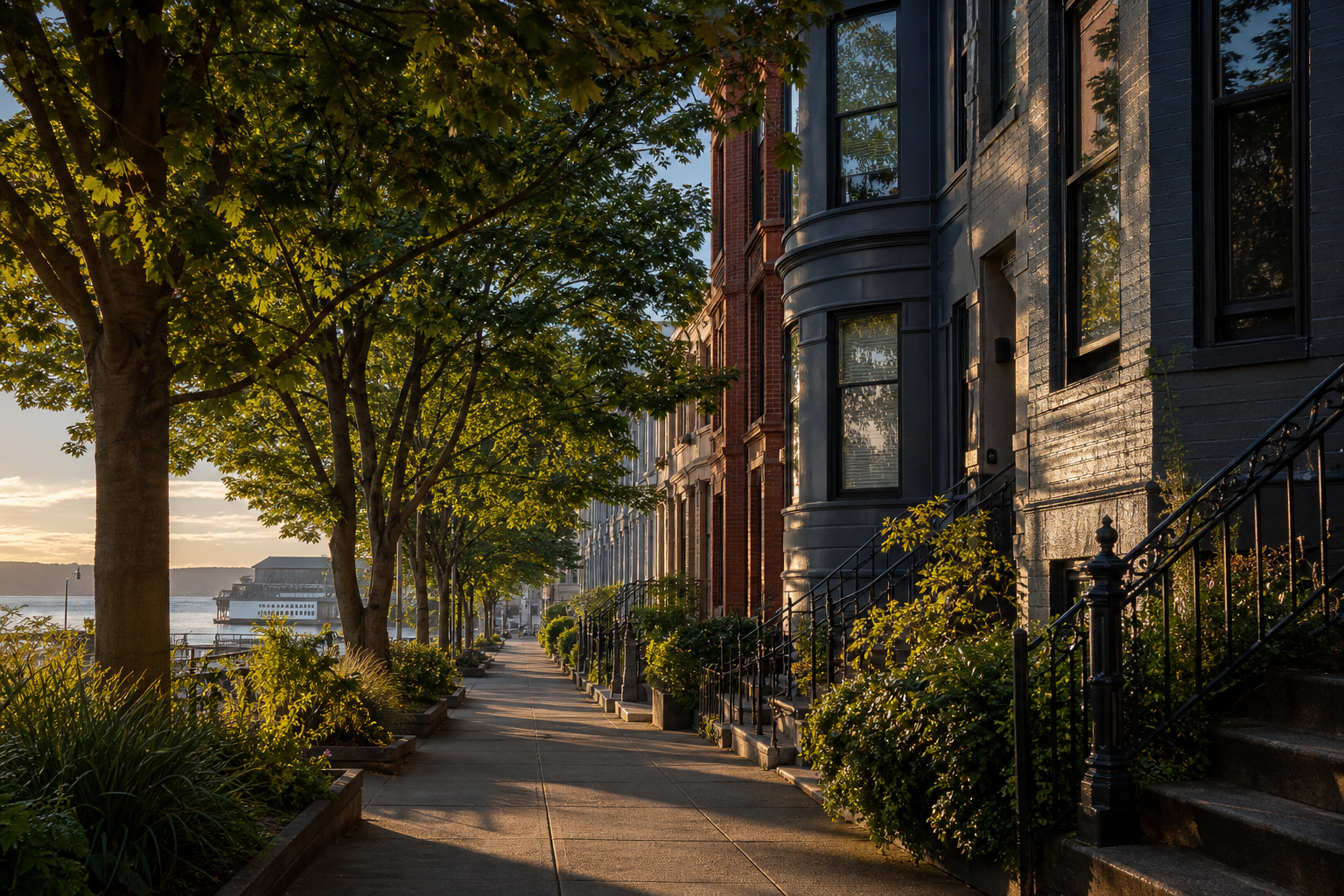
Seattle's Waterfront Is Finished. What That Means for Nearby Real Estate
Seattle's $806 million waterfront transformation is no longer a future plan. The major construction is done, the public spaces are open, and in 2025 the new Waterfront Park drew roughly 8.4 million visitors. For buyers and sellers in Belltown, Pioneer Square, Downtown, and around Pike Place Market, the question has shifted from what this will do to what it's doing now. The answer depends almost entirely on where a specific property sits relative to the promenade, Overlook Walk, and the rebuilt piers.
Key Takeaways
The Waterfront Seattle Program is an $806 million, 17-block public infrastructure overhaul. Pier 58 reopened in July 2025 as the final piece, completing Waterfront Park.
The Park Promenade creates a continuous pedestrian and protected bike connection from Pioneer Square to the Seattle Aquarium, with direct access to the Colman Dock ferry terminal.
Overlook Walk, open since October 2024, links Pike Place Market's MarketFront to the waterfront without crossing Alaskan Way.
This is a public space project, not a private development program. No new housing was built on the waterfront itself.
Micro-location drives everything here. A unit facing the promenade performs differently than one three blocks inland with the same address prefix.
What Actually Got Built
The program covers 17 blocks with a total budget of $806 million, split roughly between the Alaskan Way pedestrian promenade at $399 million, Overlook Walk and east-west connections at $199 million, pier rehabilitation at $111 million, and the Seattle Aquarium expansion at $54 million.
What's open and in daily use: Pier 62, which reopened in 2020 as the first piece. The Park Promenade, running continuously from Pioneer Square to the Aquarium with a protected bike lane and direct ferry terminal access. Overlook Walk, providing a grade-separated route from MarketFront down to the water. And Pier 58, which reopened in July 2025 with a new playground and park space, completing Waterfront Park.
A buyer asking me today whether the waterfront is going to be nice is asking the wrong question. It already is. The useful question is whether a specific unit or block captures that value.
What the project didn't include
This is a public realm and mobility project, not a development program. No residential towers, office buildings, or retail complexes were built along the promenade. Whatever real estate effect exists flows from walkability, open space, ferry and transit access, and visitor activity, not from new housing supply on the waterfront.
Which Neighborhoods Are Actually Affected
The program area runs through Downtown, Belltown, the Pike Place Market district, and Pioneer Square. Those four are where the physical improvements land.
Downtown and Belltown sit at the core. Overlook Walk connects from MarketFront through public elevators down to promenade level, which makes high-rise condos near the Market meaningfully more connected to the water than they were before 2024. In this segment the building matters as much as the unit. Floor level, view corridor, and exposure to event noise on the promenade all vary enormously within a single address, which is why I work through this building by building rather than by neighborhood.
Pioneer Square anchors the southern end, connected by the Railroad Way pedestrian plaza. The historic building stock means buyers are generally looking at condos and lofts, and the waterfront connection adds a real amenity that wasn't there at this level before. The tradeoff is proximity to Colman Dock, so ferry traffic and event noise are genuine considerations for any west-facing unit.
Everywhere else benefits from a more livable downtown in a general sense, but not from direct proximity. If a buyer is weighing Columbia City against a downtown condo partly because of the waterfront, that's a lifestyle and commute conversation rather than a proximity one.
Market Context
| Area | Median Sale Price | Median Days on Market |
|---|---|---|
| Ballard | $899,000 | 57 |
| Beacon Hill | $770,000 | 52 |
| Belltown | $484,999 | 41 |
| Capitol Hill | $870,000 | 48 |
| Central District | $792,000 | 48 |
| Columbia City | $724,950 | 55 |
| Denny Triangle | $650,000 | 41 |
| Downtown Seattle | $747,625 | 51 |
| Georgetown | $549,950 | 25 |
Trailing 90 days, area-level medians. Individual values vary by condition, street, build year, and timing.
Belltown and Denny Triangle, the two most waterfront-adjacent neighborhoods in this set, are the more accessible price points and sit mid-pack on pace at 41 days. Downtown is at $747,625 and 51 days. I'd be cautious about reading a waterfront premium into any of these figures. These are neighborhood-level medians covering hundreds of buildings at varying distances from the water, and they can't isolate the effect of a promenade three blocks away. If a premium exists, it shows up at the building and unit level, in view corridors and walking distance, and that takes a comparable sales analysis rather than a median.
The Real Tradeoffs
The improvements are significant. Proximity to a popular public space also cuts both ways, and I'd rather a client hear that before they buy than six months after.
On the upside, the promenade, Overlook Walk, and protected bike lane create one of the most walkable stretches in the city, which matters a great deal for car-free or car-light households. Direct pedestrian access to Colman Dock puts West Seattle and Bainbridge ferry service a short walk away. Pier 62 and the promenade provide waterfront open space that's genuinely scarce in a dense urban market. And the Overlook Walk connection to the Aquarium's Ocean Pavilion and MarketFront draws steady foot traffic that supports nearby retail.
On the other side, 8.4 million annual visitors means event noise, weekend crowds, and heavy summer foot traffic. Lower floors facing the water feel this considerably more than higher or set-back units. The neighborhood's rhythm shifts seasonally with tourism. Waterfront-adjacent parcels carry different flood risk profiles than inland homes, and FEMA's flood map service is the right starting point for any specific address, since insurance costs vary significantly by zone and elevation. And Alaskan Way has been rebuilt as a surface street with fewer vehicle lanes, which is intentional but does change traffic patterns for residents who drive.
Which floor, which direction, how you commute, whether you work from home. Those details decide whether the promenade is an amenity or a nuisance for you specifically. Worth settling before you make an offer.
If you want to work through what's actually available near the corridor and how a specific building sits within it, reach out and we'll go block by block.
Frequently Asked Questions
Which neighborhoods are closest to the new Waterfront Park?
Pioneer Square, Downtown, Belltown, and the Pike Place Market district. The 17-block program area runs through all four, with the Park Promenade as the north-south spine and Overlook Walk connecting the Market to the water. Properties vary widely by block and building, so the specific location matters far more than the neighborhood name.
Does Overlook Walk make nearby condos more desirable?
It's a genuine new amenity. Since October 2024 it has provided a grade-separated route between MarketFront and the promenade with no street crossing, which meaningfully improves walkability to both the Market and the Aquarium. Whether that translates into a measurable price premium depends on the specific unit, floor, and building. The physical connection is verifiable; a specific dollar effect on any property type is not.
Is the waterfront easier to reach from downtown now?
Yes. Alaskan Way is a surface street with a protected bike lane and improved pedestrian crossings, replacing the elevated viaduct that used to wall the water off from downtown. The program spent $199 million specifically on east-west connections and Overlook Walk. The waterfront is more accessible on foot and by bike than at any point in recent memory.
What are the drawbacks of living near the waterfront?
Noise and crowds from a space that drew 8.4 million visitors last year, seasonal tourism pressure, potential flood zone exposure for parcels nearest the shoreline, and changed traffic patterns on Alaskan Way. How much any of that affects you comes down to your specific unit, floor, and orientation.
Will events and foot traffic affect residents?
In some buildings, yes, and it varies a great deal. Pier 62 and the promenade host public events, and the Ocean Pavilion draws steady visitors. Lower floors facing the promenade feel it most; higher or set-back units considerably less. If that's a concern, it's worth looking at specific floor plans and orientations before writing an offer, since it's the kind of thing a listing photo won't tell you.
About Kim Reidy
Kim Reidy is a Senior Broker and Director of Relocation at Pointe3 Real Estate in Seattle who has been helping corporate transferees and individuals find the right neighborhood since 2010. A Certified Negotiation Expert (CNE) and Certified Buyer Agent Expert (CBAE), she's known as Seattle's "neighborhood whisperer."
Pointe3 Real Estate · (206) 237-6391
Equal Housing Opportunity. Kim Reidy is licensed in Washington State, regulated by the Washington State Department of Licensing. Market data reflects trailing 90-day activity and changes continuously. Flood risk and insurance costs should be verified for any specific parcel. Property search powered by RealScout pulling live MLS data; all information should be independently reviewed and verified for accuracy.