Finding an ADA-Friendly Home in Seattle: A Practical Guide
An accessible home in Seattle is a chain of things that all have to work: the curb ramp, the crossing, the entry, the elevator, the hallway, the doorway, the bathroom. A break anywhere in that chain makes the rest of it irrelevant. Because Seattle's topography changes block by block, the neighborhood name tells you very little. The building, the route to transit, and the measurements inside the unit tell you almost everything.
This guide covers where the flat ground actually is, a building-age filter that narrows the search faster than anything else, what to measure, what rights you have to modify a unit, and the financing and tax programs that most buyers never hear about.
Key Takeaways
Units in elevator buildings first occupied after March 13, 1991 are covered by the Fair Housing Act's design and construction requirements, which makes building age one of the most efficient filters in an accessibility search.
Washington's HomeChoice program offers up to $15,000 in downpayment assistance to buyers with a disability or with a household member who has one, with no monthly payments.
King County's property tax exemption is available to people with disabilities at any age, not only seniors, subject to an income limit.
Under fair housing law, a condo association generally must allow reasonable modifications to a unit and to common areas, at the owner's expense.
Legal compliance and daily usability are not the same thing. Measure the unit against your own equipment before you make an offer.
Where the Flat Ground Actually Is
Terrain is the first filter, and it's worth being precise, because the common shorthand is misleading.
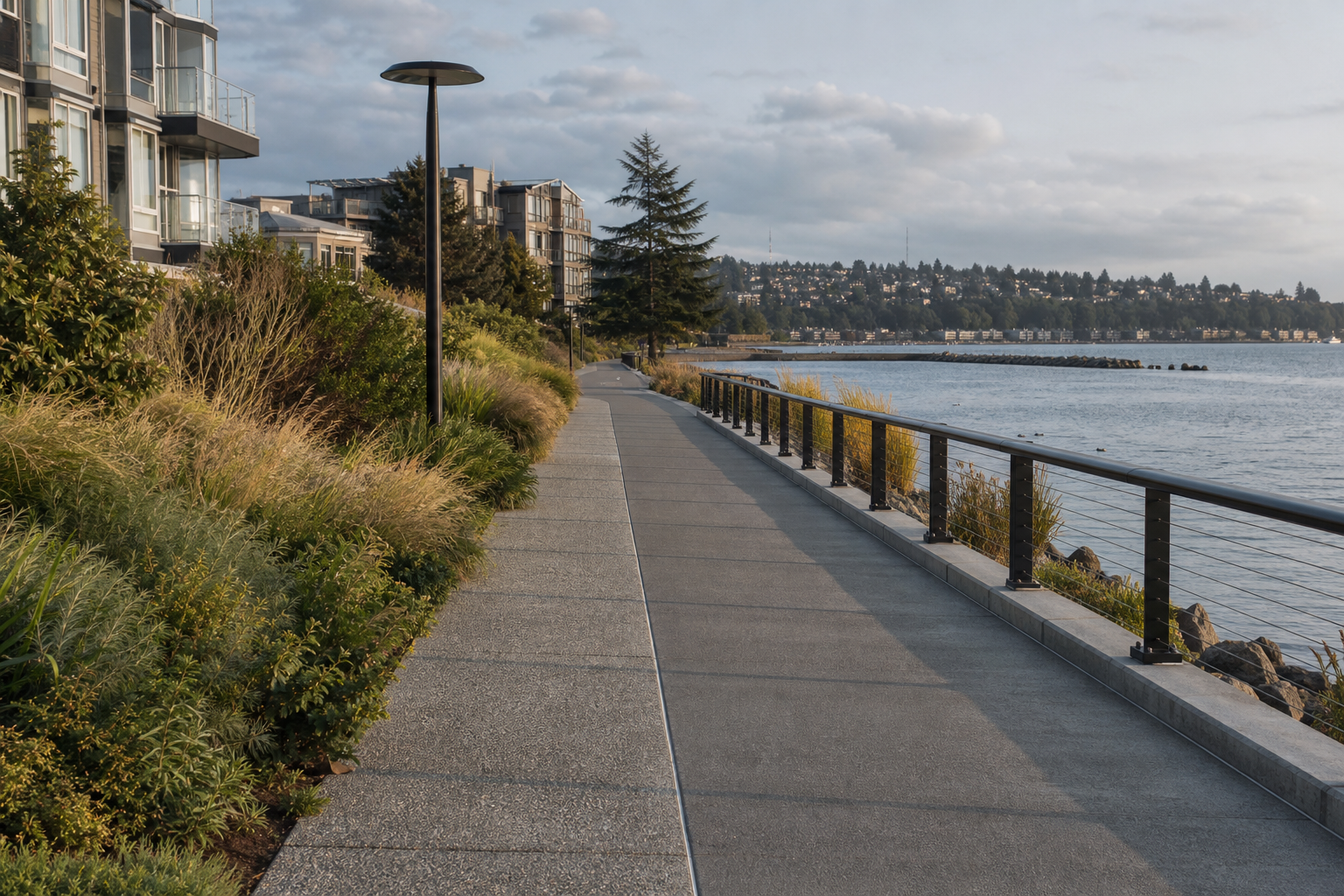
South Lake Union and Denny Triangle sit on genuinely level ground in every direction. Both are dominated by newer construction, which matters more than it sounds like it does for reasons covered below.
Belltown and the downtown core are flat north to south along the avenues and steep east to west across them. That's the Pike and Pine climb. A unit on First or Second Avenue is a completely different daily experience from one four blocks uphill with the same neighborhood name on the listing. Downtown also carries the deepest inventory of elevator-served high-rises with professional management.
Lower Queen Anne, or Uptown, is flat across the blocks between Seattle Center and the Mercer corridor, with a grocery, pharmacy, medical offices, and a major park all within a short level trip. Two limits: no Link station, and the hill rises sharply north of Roy Street, so the usable area is narrower than the neighborhood boundary suggests.
Capitol Hill's lower blocks near Broadway and the Link station are relatively flat, and the neighborhood climbs hard east and west. Block selection matters here more than almost anywhere in the city.
Columbia City has a Link station, a flat commercial corridor, and a mix of newer and renovated buildings.
Georgetown is level throughout and the least expensive option in this comparison, with thinner transit coverage and fewer everyday destinations within rolling distance.
I'd rather tell someone directly that a specific block in a walkable neighborhood won't work than let them fall for a listing that puts them on a steep, curb-cut-free stretch every time they leave the building.
The Building-Age Filter Most Buyers Miss
This is the single most useful search shortcut, and almost nobody mentions it.
The Fair Housing Act's design and construction requirements apply to multifamily buildings of four or more units designed and constructed for first occupancy after March 13, 1991. In buildings with an elevator, every unit is covered. In buildings without one, the ground-floor units are covered.
Seven requirements apply to covered units and buildings:
An accessible building entrance on an accessible route, unless terrain makes it impractical. Accessible and usable common areas, including parking, lobbies, laundry, storage, and recreation space. Doors wide enough for wheelchair passage throughout. An accessible route into and through the unit. Light switches, outlets, and thermostats in reachable locations. Reinforcement in bathroom walls so grab bars can be added later. And kitchens and bathrooms designed so a wheelchair user can maneuver in them.
That last pair matters enormously in practice, and so does the grab bar reinforcement, because it means a modification you may want later is a straightforward job rather than a wall rebuild.
What this gives you is a filter. An elevator building first occupied after 1991 starts from a meaningfully better baseline than an older one. It does not guarantee the unit works for you, since these are minimum design standards rather than full ADA accessibility, and compliance in practice varies. But it changes the odds enough to be worth building a search around, especially in South Lake Union, Denny Triangle, and the newer downtown towers where most of the stock postdates 1991.
Older buildings aren't out of the question. They just require more verification and more willingness to modify.
Verifying Transit From a Specific Address
Most searches go wrong here. People check a walkability score, see "excellent transit," and stop.
Buses. Every King County Metro bus has a lift or ramp. That doesn't make the stop accessible. A lift-equipped bus does nothing about a steep approach, a missing curb ramp, broken pavement, or a boarding area that puts you in the travel lane. Before you make an offer, visit the nearest stop at the hour you'd actually use it and check the ramp, the pavement, the slope, and whether the boarding area works in rain. Seattle winters make surface conditions a real variable.
Link. Stations with above- or below-grade platforms have elevators, and station pages identify where they are. A station's accessible designation doesn't tell you which entrance has the elevator, what happens when it's out of service, or what the sidewalk between the station exit and your front door looks like. Do a dry run of the whole route, both directions, at the times you'd travel. Elevator reliability is an operational reality, not a guaranteed feature.
Access paratransit. Metro's Access program provides shared-ride service for people whose disabilities prevent them from using regular bus or rail. ADA-required service covers within three-quarters of a mile of non-commuter fixed-route service during the hours those routes run, and Metro extends past that minimum in some areas. Access is scheduled and shared, not on-demand, and eligibility is based on whether a disability prevents you from performing the tasks of riding regular service rather than on a diagnosis. Applicants are evaluated before they can use it. If Access is part of the plan, confirm eligibility, pickup procedures, hours, and the real distance from the front door to the pickup point before closing.
King County also funds transit instruction for riders with disabilities, the Solid Ground downtown circulator, and the Hyde Shuttle. These matter when a neighborhood has the right destinations but difficult slopes or gaps in fixed-route coverage.
Build in redundancy. Aim for two workable options from any home you're serious about, whether that's an accessible bus route plus nearby rail, or paratransit plus a shuttle.
What to Inspect
A building described as ADA-compliant means its common areas met a standard at some point. It says nothing about whether a specific unit works for a specific person's equipment.
The route from sidewalk to unit. Test every link: curb ramp, crossing, entry threshold, lobby door weight and opener, elevator size and reliability, hallway width, unit entrance clearance, and access to mail, trash, parking, and outdoor areas.
Ask management directly how often elevators go out of service, whether there's a service-elevator restriction during move-ins, whether automatic openers work on every accessible entry, and whether the entry system can be operated from a seated position. Get it in writing or verify in person.
Inside the unit, measure. Doorway clear width, where 32 inches is the minimum and 36 is more usable for most power chairs. Turning space, with a 60-inch circle as the benchmark, checked in the bathroom, kitchen, and bedroom. Bathroom transfer space, meaning the distance from the toilet to the nearest wall or fixture, and whether a roll-in shower exists or can be added. Kitchen reach ranges, counter heights, under-counter clearance, and appliance placement. Threshold lips between rooms and the floor surface itself, since thick carpet creates real resistance for a manual chair. And emergency egress, specifically what the plan is when elevators are unavailable.
Your Right to Modify
This is the part that changes what's possible, and it's worth knowing before you rule out a building.
Under fair housing law, a housing provider, including a condominium association, generally must permit reasonable modifications to a unit and to common areas when those modifications are necessary for a person with a disability to fully use and enjoy the home. The owner typically pays for the work. The association can impose reasonable conditions, such as requiring that the work be done properly and with appropriate permits, and in rental contexts can sometimes require restoration later.
In practice this means an association generally cannot simply refuse a grab bar installation, a ramp at a common entry, a door-widening inside a unit, or a reserved accessible parking space near the entrance because it doesn't like the look of it. Associations do sometimes push back, often out of unfamiliarity rather than bad faith.
Two practical notes. First, raise the modification question during your due diligence, not after closing, and read the governing documents for anything that would complicate the specific change you have in mind. Second, if a change you need is substantial, get a contractor's estimate before you remove contingencies, so the cost is part of your purchase decision rather than a surprise afterward.
Financing and Tax Programs
HomeChoice. The Washington State Housing Finance Commission's HomeChoice program offers up to $15,000 in downpayment assistance to a borrower with a disability or to a household that includes a family member with one, defined by Americans with Disabilities Act standards. There are no monthly payments. The balance comes due when you sell, refinance, stop using the home as your primary residence, or reach the end of the term. Income caps currently run to $164,400 in King and Snohomish counties. First-time buyer status is generally required unless you're purchasing in a targeted area, and the program requires a free homebuyer education class plus a one-on-one counseling session.
This program is specifically designed for this situation and it's routinely missed, including in most first-time buyer guides. Ask your lender about it by name, and confirm current amounts and limits directly, since program terms change.
The Commission runs several other assistance programs that may stack or substitute, including Home Advantage and the Covenant Homeownership Program, each with its own criteria. A lender experienced with Commission programs is the right person to sort out which combination fits.
Property tax relief. King County's property tax exemption is available to people with disabilities at any age, not only to seniors. The current income limit is $84,000 annually, including Social Security and other sources, and you must own the home as of December 31 of the prior year and occupy it at least nine months a year. If you don't receive SSI, a proof of disability form verifies eligibility. The county recommends applying through its online portal.
This is ongoing money, not a one-time benefit, and it should be part of the affordability math on any home you're considering. Verify current thresholds with the Assessor, since the income limit is adjusted periodically.
The Route Audit
A neighborhood can score well on destination density and still be hard to live in. Audit the routes to the places that matter most, meaning grocery, pharmacy, clinic, park, café, and transit, in both directions. Record slope, curb ramps, crossing signal timing, sidewalk width, pavement condition, lighting, and construction detours. Seattle's hills mean a route that works one way can be considerably harder coming back, and a signal timed for an average walking pace is a different proposition at a different pace.
Do this before you narrow to a shortlist, not after you've made an offer.
If you want help building the checklist and the search strategy around what you actually need, reach out and we'll work through it together.
Frequently Asked Questions
Which Seattle neighborhoods have the flattest streets?
South Lake Union and Denny Triangle are the most consistently level, with Lower Queen Anne, Georgetown, and the Columbia City corridor also flat. Belltown and downtown are flat along the avenues and steep across them, so the specific block decides it. Capitol Hill is workable near Broadway and climbs sharply away from it.
Does building age really matter?
Quite a bit. Elevator buildings first occupied after March 13, 1991 are covered by the Fair Housing Act's design requirements, which include wider doors, accessible routes through the unit, reachable controls, grab bar reinforcement in bathroom walls, and maneuverable kitchens and baths. It's a minimum standard rather than full accessibility, but it's a far better starting point than older stock and it narrows a search quickly.
Can a condo association refuse to let me modify my unit?
Generally no, when the modification is reasonable and necessary for a person with a disability to fully use the home. The owner typically bears the cost, and the association can set reasonable conditions about how the work is done. Raise it during due diligence and read the governing documents before you remove contingencies.
Is there downpayment help specifically for buyers with disabilities?
Yes. Washington's HomeChoice program offers up to $15,000 with no monthly payments, repaid when you sell, refinance, or leave the home. It's open to a borrower with a disability or a household including a family member with one, subject to income limits. Ask your lender about it by name, since it's frequently overlooked.
Are Link stations wheelchair accessible?
Stations with above- or below-grade platforms have elevators. Reliability varies, and the route from the station exit to a specific address is a separate question. Confirm which entrance has elevator access, what the backup is when one is down, and what the sidewalk connection looks like.
How do I find a home near an accessible bus stop?
Every Metro bus has a lift or ramp, but accessible vehicles and accessible stops are different things. Visit the stops nearest any property at the hours you'd travel and check the curb ramp, pavement, boarding slope, and approach route.
Can I get property tax relief?
King County's exemption is available to people with disabilities at any age, subject to an income limit currently set at $84,000 including Social Security, along with ownership and occupancy requirements. It's worth factoring into affordability from the start rather than treating it as an afterthought.
About Kim Reidy
Kim Reidy is a Senior Broker and Director of Relocation at Pointe3 Real Estate in Seattle who has been helping corporate transferees and individuals find the right neighborhood since 2010. A Certified Negotiation Expert (CNE) and Certified Buyer Agent Expert (CBAE), she's known as Seattle's "neighborhood whisperer."
Pointe3 Real Estate · (206) 237-6391
Equal Housing Opportunity. Kim Reidy is licensed in Washington State, regulated by the Washington State Department of Licensing. This article is general information and is not legal advice. Fair housing rights, program terms, income limits, and transit service all change; verify current details with a qualified attorney, your lender, the Washington State Housing Finance Commission, the King County Assessor, King County Metro, or Sound Transit as applicable.